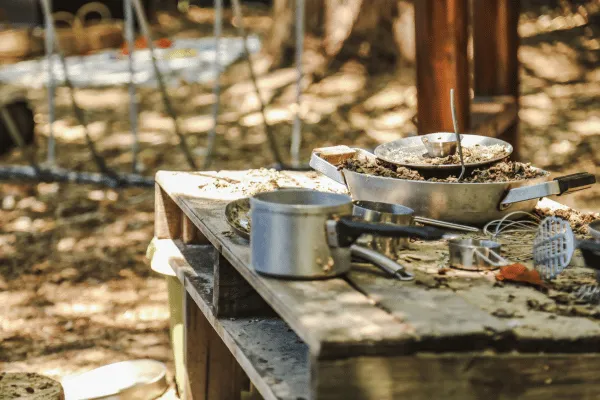
What Does Science Look Like in the Mud Kitchen?
Exploring STEM and sustainability through children's play everyday.
Science Week 2025 invites us to decode the universe — but what if the universe starts right here in your outdoor area, in a muddy corner filled with spoons, scoops, and overflowing pots?
In early childhood education, science doesn’t start with labs and formulas. It begins with curiosity, wonder, and the urge to make sense of the world. And few places ignite this kind of thinking more naturally than the mud kitchen.
🌿 Everyday STEM in Action
When children mix water and soil, observe textures, test recipes, and negotiate roles, they’re not just “playing” — they’re:
Hypothesising ("What happens if I add more water?")
Observing cause and effect ("It’s runnier now!")
Exploring properties of materials ("This is sticky... this is crumbly")
Classifying, comparing, and measuring (even without standard units!)
These are foundational scientific thinking skills, and they emerge organically through messy, joyful, hands-on exploration.
🔄 Systems Thinking in the Mud Kitchen
Science and sustainability go hand-in-hand. When children:
Notice where water comes from and where it flows,
Reuse containers and natural materials,
See how weather changes affect their environment and play,
…they are beginning to explore systems, cycles, and interconnection — key concepts not only in sustainability but also in real-world STEM.
We don’t need to teach quantum physics to young children — but we can nurture the dispositions and thinking processes that make future inquiry possible. That’s what matters.
📚 Link to the EYLF and Sustainability
The EYLF 2.0 invites us to engage children as active participants and inquirers. It recognises that:
“Learning environments that offer complexity, challenge and multiple opportunities for exploration foster children's creativity, problem-solving and scientific thinking.” (Outcome 4)
The mud kitchen is that kind of environment.
It also provides an accessible way to embed the sustainability principle, especially when educators intentionally connect play to:
Natural materials
Care for Country
Reuse and resourcefulness
Understanding environmental impact
💡 Tips for Making the Most of Mud Kitchen Science
Want to highlight the science in your service’s mud kitchen? Here are a few simple strategies:
Pose questions instead of giving instructions
“What are you hoping to make?” “What happened when you added that?”Document the discoveries – photos, dictations, drawings
Introduce vocabulary through play: dissolve, solid, squishy, mixture, pour, sieve
Link to stories – like Who Sank the Boat? By Pamela Allen or All Through the Year by Jane Godwin
Celebrate process over product – the real learning is in the thinking, not the “pie”
🌏 From Making Mud Pies to Making Meaning: STEM Meets Sustainability
When we reframe everyday play as scientific inquiry, we help educators feel confident and capable — not just in delivering STEM content, but in creating a culture of exploration and sustainability.
Science Week is a wonderful prompt to notice what’s already happening, and to go a step deeper.
Because sometimes, decoding the universe starts with a muddy spoon and a curious mind.
Want More?
📥 Download our free “Sustainability Sparks for Science Week” – STEM ideas grounded in nature-based play. 👉Get Instant Access Here


